Artificial intelligence (AI) has moved from a futuristic idea to a transformative force shaping business, technology, and everyday life. AI now supports everything from content suggestions to advanced research, and its capabilities are evolving rapidly. However, the term “AI” often serves as an umbrella for very different technologies, thus it is difficult to understand what AI truly is and what it is not.
To make the concept cleaner, AI can be categorized through two key lenses about what it can achieve and how it operates. This framework helps distinguish today’s specialized systems from more advanced, theoretical forms of intelligence.
As the global AI market continues its rapid growth trajectory, understanding these types of AI is essential for navigating both its current applications and its future potential.
Understanding Artificial Intelligence (AI)
Before digging deeper into different types of AI, let’s first break down what AI truly is.
AI refers to the simulation of human intelligence processes by machines, especially computer systems. These processes include:
- Learning: The acquisition of information and rules for using the information.
- Reasoning: Using rules to reach approximate or definite conclusions.
- Self-correction: Detecting errors and improving its performance over time without being explicitly reprogrammed.
AI technology encompasses a broad field that aims to create intelligent agents. They are systems that can perceive their environment and take actions to achieve their programmed goals.
The field is continuously powered by advancements in algorithms and computational power. That makes it a dynamic and rapidly progressing area of technological development.
7 types of AI: Categorized by capabilities and functionalities
AI can be classified through 2 primary lenses: its capability (what it can do) and its functionality (how it works).
| Classification | AI type | What it means | Memory | Learning ability | Current status |
| Capability | Artificial Narrow Intelligence (ANI) | Specialized AI designed for one specific task | Task-specific | Yes (within narrow domain) | Exists today |
| Artificial General Intelligence (AGI) | Human-level intelligence across all domains | Full, flexible memory | Yes (cross-domain learning) | Theoretical | |
| Artificial Super Intelligence (ASI) | Intelligence far beyond human abilities | Beyond human | Beyond human | Hypothetical | |
| Functionality | Reactive Machines | Respond only to current input | No memory | No learning | Exists |
| Limited Memory AI | Uses recent past data to improve decisions | Short-term | Yes (recent data) | Common today | |
| Theory of Mind AI | Understands emotions, beliefs, intentions | Advanced | Contextual/social learning | Mostly theoretical | |
| Self-Aware AI | Conscious, self-aware systems | Human-like or beyond | Fully autonomous | Science fiction |
The capability classification
The capability classification focuses on AI’s potential to perform tasks at a level comparable to human intelligence. It ranges from highly specialized functions to broad cognitive abilities.
Artificial Narrow Intelligence (ANI): The specialist
Narrow AI represents the most common and practical form of AI we encounter daily. Narrow AI calls forth its ability when it comes to specific and well-defined tasks. Therefore, it remains completely useless outside its designated domain.
Most AI applications fall into this category because narrow AI systems can achieve superhuman performance within their limited scope. This specialization is a feature that makes narrow AI both reliable and deployable at scale.
Above all of that, what makes narrow AI particularly valuable in current AI categories is its measurable performance and predictable behavior. The systems can be thoroughly tested, validated, and trusted within their specific domains. This sets the stage for understanding how these specialists compare to their all-around counterparts.
Examples of ANI abound in our daily lives: voice assistants like Siri and Alexa, recommendation engines on streaming services, spam filters in our email, facial recognition systems, and sophisticated chatbots.
Even self-driving cars, while complex, operate within the confines of narrow AI. They are exceptionally skilled at navigating roads and avoiding obstacles, but cannot, for instance, engage in philosophical debate or compose a symphony.
Artificial General Intelligence (AGI): The all-rounder
Artificial General Intelligence (AGI), also known as General AI, is the holy grail of artificial intelligence development. This system can understand, learn, and apply knowledge across any domain with human-level cognitive abilities. While narrow AI systems perform better in specific tasks, General AI would possess the flexibility to tackle any intellectual challenge a human could handle.
Currently, General AI remains purely theoretical. While we have made remarkable progress in narrow applications, creating truly general intelligence requires breakthroughs in areas like reasoning, creativity, and contextual understanding. Simultaneously, it must span multiple domains.
Predicting its arrival is challenging, however, recent forecasts have given the median forecast for AGI arrival closer to 2030, acknowledging the inherent uncertainty and complexity in predicting AI’s trajectory (Source: Will we have AGI by 2030? by Benjamin Todd).
Artificial Super Intelligence (ASI): Beyond human comprehension
Artificial Superintelligence (ASI) is a theoretical form of AI that would surpass human intelligence and capabilities in virtually all fields, including scientific creativity, general wisdom, and social skills.
An ASI would not only be faster and more capable than humans but would possess cognitive abilities that are difficult, if not impossible, for humans to comprehend. The concept of ASI is largely speculative and resides within the field of science fiction and theoretical futurism.
While AGI is the goal of replicating human intelligence, ASI represents an intelligence that far exceeds it. The potential implications of ASI are vast and debated, ranging from solving humanity’s greatest challenges to posing existential risks.
The functionality classification
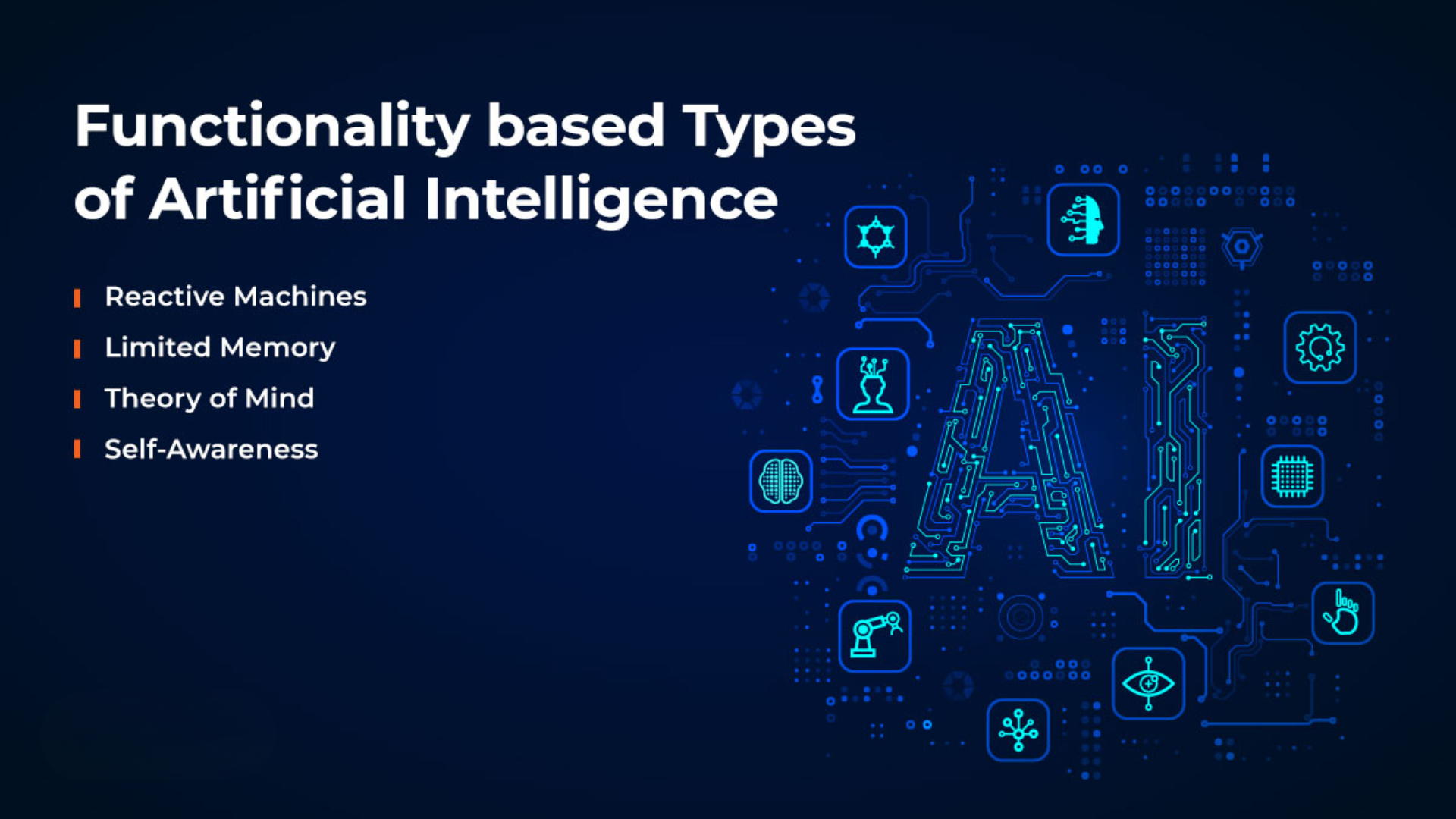
Under the functional framework, AI systems are categorized by their information-processing capabilities, learning mechanisms, and environmental awareness. This model reveals the maturity of their cognitive architecture and interaction dynamics.
Reactive Machine AI: The most basic form
Reactive machines constitute the most basic category within AI systems. They operate solely on the present data, without any memory of past experiences. These systems are programmed to respond to specific inputs in a predictable way. They do not learn from the past, nor do they form memories to inform future decisions.
Let’s bring back the classic IBM’s Deep Blue – the chess-playing computer that defeated Garry Kasparov as an example. Deep Blue could analyze the current board state and predict possible moves, but it did not “remember” previous games or learn from its opponent’s strategies beyond what was immediately on the board. These systems are deterministic: given the same input, they will always produce the same output.
Limited Memory AI: Learning from the recent past
In contrast of purely reactive systems, Limited Memory AI can access prior data points. By analyzing recent experiences, these systems refine their outputs and improve performance in changing environments.
Many of the AI systems we interact with daily are under this category. For instance, chatbots like ChatGPT use conversational history to maintain context and provide more coherent responses. Self-driving cars utilize sensor data from the immediate past to navigate roads, adjust speed, and avoid obstacles.
Recommendation engines also use recent viewing or purchasing history to suggest relevant content. While they can learn from recent data, their memory is transient and not designed for long-term learning or the accumulation of a comprehensive knowledge base akin to human memory.
Theory of Mind AI
Theory of Mind AI is a more advanced, largely theoretical concept that refers to AI systems capable of understanding emotions, beliefs, intentions, and mental states of others. This type of AI would possess a rudimentary understanding of social cues and human psychology. This feature enables it to interact more naturally and empathetically.
Such systems could predict behavior based on perceived intentions, which is crucial for complex social interactions. Developing Theory of Mind AI is a significant challenge, as it requires machines to go beyond pattern recognition to grasp the subjective experiences and underlying motivations of individuals.
While current AI can simulate emotional responses or detect sentiment, true understanding of “mind” remains an aspiration.
Self-Aware AI
At the top of AI evolution, self-aware AI is introduced as a theoretical concept in which machines have consciousness and awareness of themselves. These systems would not only understand their own existence but would also be capable of subjective experiences and introspection. This concept delves into philosophical territory, raising profound questions about the nature of consciousness, sentience, and what it means to be alive.
Self-aware AI is currently the stuff of science fiction, and there is no scientific consensus on whether it is achievable or how it might be developed. Its potential implications, both positive and negative, are vast and deeply debated.
Enabling technologies of all AI types

The development and advancement of all these above AI types, from the simplest to the most complex, are solidified by a suite of powerful enabling technologies. These technologies are the engines that drive AI’s progress and enable its diverse applications.
- Machine Learning (ML): Enables systems to learn from data instead of following fixed rules. ML identifies patterns, makes predictions, and improves performance over time. It powers most modern AI applications, especially Narrow AI and Limited Memory systems.
- Deep Learning (DL): A subset of ML that uses multi-layered neural networks inspired by the human brain. It excels at recognizing complex patterns in large datasets, making it essential for image recognition, speech processing, and advanced AI models.
- Natural Language Processing (NLP): Allows machines to understand, interpret, and generate human language. NLP drives chatbots, virtual assistants, translation tools, sentiment analysis, and generative AI systems.
- Computer Vision: Enables machines to interpret and analyze visual data such as images and videos. It is crucial for self-driving cars, facial recognition, medical imaging, robotics, and surveillance systems.
- Robotics & Robotic Process Automation (RPA): Robotics applies AI to physical machines so they can perceive, decide, and act in the real world. RPA automates repetitive digital tasks, mimicking human interactions with software systems.
- Expert Systems (Symbolic AI / GOFAI): Rule-based AI systems that encode human expertise into logical frameworks. While less data-driven than ML, they remain valuable for structured decision-making and explainable reasoning, often complementing modern AI approaches.
Together, these technologies form the technological pillars of AI. As they continue to evolve and converge, they expand the boundaries of what AI systems can perceive, learn, and accomplish.
Wrap up
AI has never been a single technology, but a spectrum of systems defined by both capability and functionality. Today, most practical applications fall under Artificial Narrow Intelligence, powered by technologies like Machine Learning, Deep Learning, NLP, and Computer Vision. More advanced forms, such as AGI and ASI, remain theoretical, while functional models beyond Limited Memory are still largely aspirational.
As AI continues to evolve, the lines between these categories will become increasingly interconnected. Innovation is steadily pushing the boundaries of what machines can learn, reason, and accomplish.
Yet with greater capability comes greater responsibility. Understanding the different types of AI equips businesses to adopt these systems strategically, ethically, and responsibly. This ensures AI remains a tool that augments human potential rather than replaces it.
At Varmeta, we are pioneers in the development of sophisticated AI agents for big enterprises and SMEs. We have proven track records with custom agents that understand context, utilize long-term memory, and execute reasonings with precision.
Ready to deploy your first AI agent? Book a Free Consultation with Varmeta Today and let’s build a smarter, more autonomous future together.