Artificial intelligence has dominated headlines, boardrooms, and strategic planning sessions for the past few years. Yet, despite the massive influx of investment and the rapid deployment of these technologies, a startling truth is emerging. Recent large-scale economic data reveals that the highly anticipated productivity gains from AI are, for the vast majority of businesses, currently non-existent.
If your organization has invested in artificial intelligence but has yet to see a tangible impact on your bottom line, you are not alone. In fact, you are in the overwhelming majority. Let’s dive deep into the latest research, unpack the massive perception gap between executives and employees, and explore how businesses can move past the hype to achieve real, scalable results.
NBER Study: The impact of AI on productivity and employment.
To truly understand the macroeconomic and firm-level impact of AI, we must look beyond vendor marketing and examine rigorous, large-scale data. The National Bureau of Economic Research (NBER) recently released an extensive study, detailed in Working Paper 34836, which provides a sobering look at the current state of AI in the enterprise.
This comprehensive survey gathered insights from nearly 6,000 top executives, primarily CEOs, CFOs, and CTOs. To provide a holistic view, the study also included a parallel survey of employees across four major economies: the United States, the United Kingdom, Germany, and Australia.
Conducted synchronously from November 2025 to January 2026, the survey’s primary objective was to assess the true extent of AI adoption, its actual impact over the past three years, to find out if productivity gains from AI, and the grounded expectations for the next three years. The findings challenge the mainstream narrative heavily pushed by the media, highlighting a stark contrast between technological potential and current operational reality.
AI in Firm: Major Trends and Widespread Adoption
Before analyzing the lack of results, it is crucial to understand that the absence of productivity gains from AI is not due to a lack of trying. AI adoption is increasingly widespread, penetrating almost every sector of the modern economy.
A key highlight from the NBER report states: “Adoption is highest in the US (78% of firms), followed by the UK (71%), Germany (65%), and Australia (59%). On average, 69% of all firms are currently using AI.“
How is AI Being Used?
When breaking down the specific applications, the data shows that businesses are heavily reliant on generative tools rather than deeply integrated operational systems. The most commonly cited uses include:
- Text generation using large language models – by 41% of firms on average..
- Visual content creation for marketing and design – about 30%
- Basic data processing utilizing traditional machine learning – about 20%
Who is Leading the Charge?
The research reveals distinct demographic trends among the companies leading the AI charge. The highest rates of utilization are found in young, highly productive, large-scale enterprises with higher-than-average compensation rates. Conversely, older, deeply established firms, particularly those with older management teams, are significantly lagging in their integration efforts.
However, even among the aggressive early adopters, the translation from “usage” to “value” remains fundamentally broken.
The Reality of Impact: Where Are the Productivity Gains from AI?
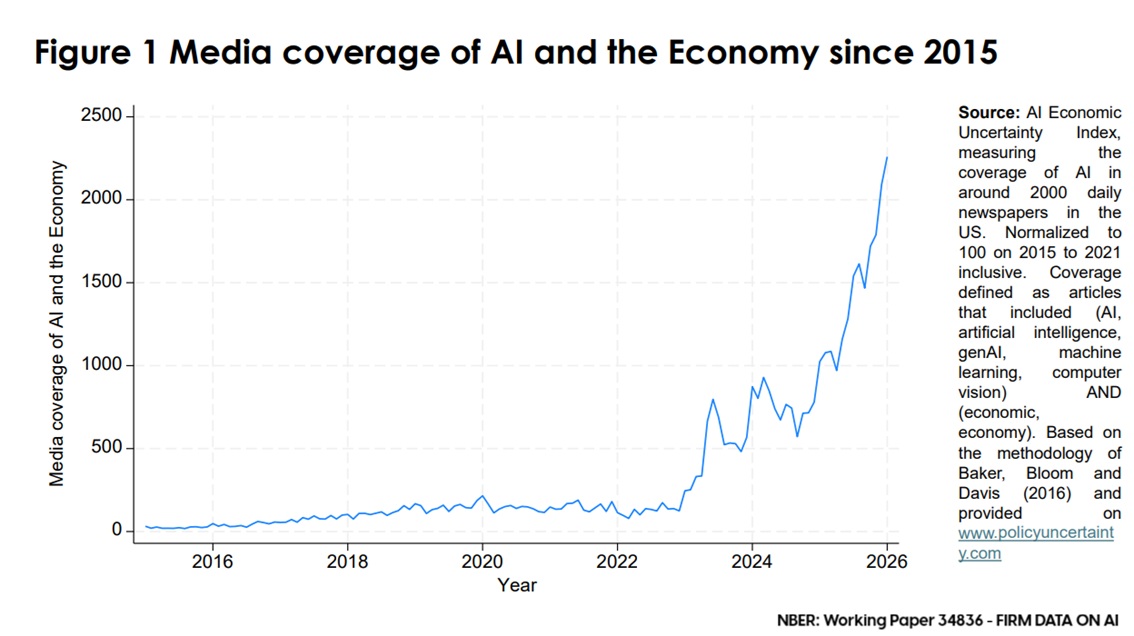
This brings us to the most critical and perhaps most shocking, revelation of the study. In stark contrast to the relentless media boom promising exponential growth and immediate operational overhauls, the actual, measurable impact of AI on employment figures and labor productivity over the past three years has been exceptionally limited.
When asked about the concrete benefits, the data paints a bleak picture for the “plug-and-play” approach to artificial intelligence:
Zero Impact on Employment for Most
Over 90% of business managers across the four surveyed countries report that AI has had absolutely no impact on their employment numbers or hiring needs over the past three years.
Stagnant Productivity
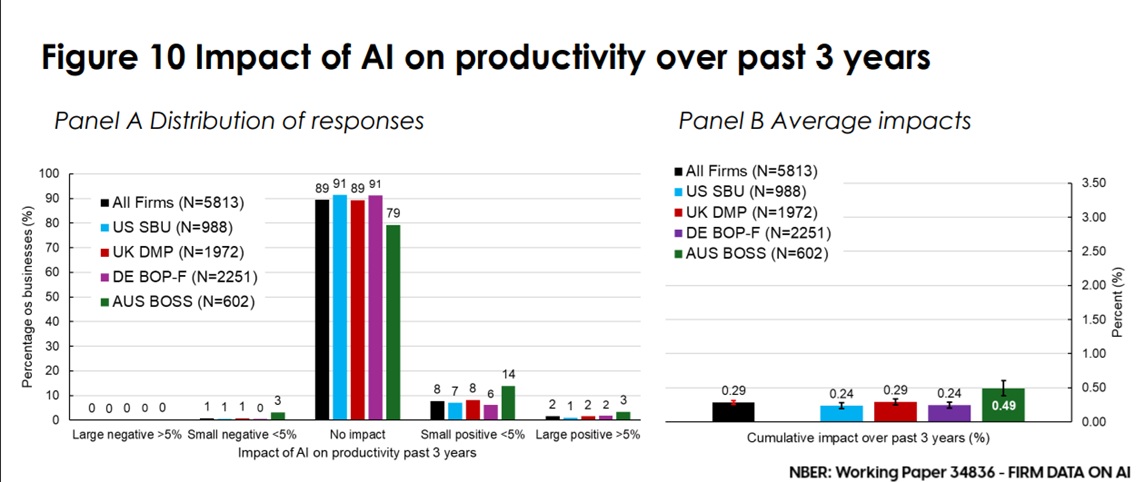
A staggering 89% of enterprises confirm that they have experienced no productivity gains from AI (measured as the volume of sales or revenue per employee).
Negligible Macro Growth
While a very small minority of highly optimized firms are witnessing positive returns, the average impact of AI on employment in the past three years is effectively zero. Meanwhile, although the companies claim there is no productivity gains from AI, the overall bump in macro labor productivity sits at a mere 0.29%.
Reality Lags Behind the Media
As noted by major financial publications analyzing similar market trends, the macroeconomic impact of AI has yet to materialize. The hype cycle has outpaced the integration cycle. Businesses are buying subscriptions to the most popular AI models, but without restructuring their internal data and workflows, these tools act as minor conveniences rather than transformative engines.
Expertise from the Varmeta Technical Leadership
“The reason 89% of companies see zero productivity gains from AI is because they treat AI like a piece of software you simply install. It is not,” explains Varmeta’s Chief Technology Officer. “Using a public language model to write emails is a convenience, not a productivity multiplier. True productivity requires architecture. It requires connecting an AI Copilot directly to your proprietary databases, CRM, and ERP systems securely. Until the AI can read your specific corporate context and execute tasks autonomously, it remains a novelty, not a utility.”
However, this stagnant metric reflects the macro-level view of C-level executives, missing the daily reality of frontline workers. For example, with IT employees, the productivity gains from AI are undeniably real. A prime example is “vibe-coding,” where developers use natural language to let AI instantly write and debug code, skyrocketing their individual output. Yet, a structural disconnect exists: while coders finish tasks ten times faster, these micro-efficiencies often hit bottlenecks in testing or compliance. Consequently, this massive workflow acceleration doesn’t immediately translate into the “revenue per employee” metrics that executives track.
Firms’ expectations of artificial intelligence impact productivity and employment.
Despite the sluggish historical performance, corporate leadership remains highly optimistic and somewhat ruthless about the next 36 months. Executives forecast that as AI systems mature and integration deepens, the technology will finally deliver on its promises, albeit with significant consequences for the workforce.
According to the NBER data, over the next three years, executives expect:
- Productivity: AI will drive a 1.4% increase in overall labor productivity.
- Output: Total corporate output and production will see a 0.8% boost.
- Employment Reduction: Crucially, leadership forecasts that AI will decrease total employment by 0.7%. This reduction won’t necessarily come from mass layoffs, but rather through hiring freezes and a reduction in new hires.
To put this into perspective, a 0.7% decrease in employment translates to an estimated 1.75 million jobs lost or displaced by 2028 across the existing companies in the US, UK, Germany, and Australia.
The Perception Gap of Employees with future job opportunity
While executives are quietly planning for automation-driven workforce reductions to finally achieve their productivity gains from AI, the workforce has a drastically different perspective. The parallel survey of employees reveals a massive, potentially dangerous “Perception Gap.”
What Employees Expect:
- Job Growth: In complete opposition to the executives’ predicted 0.7% decrease, employees believe AI will actually increase employment by 0.5%, creating new roles and opportunities.
- Slower Productivity Growth: Employees estimate a productivity boost of only 0.9%, significantly lower than the 1.4% expected by the C-suite.
The Danger of Misplaced Optimism
Workers may be severely misjudging the risks associated with AI adoption. This discrepancy suggests that employees currently view AI through rose-tinted glasses, seeing it as a collaborative assistant that will spawn new tech-centric roles. They are largely unaware of, or underestimating, the board’s strategic plans to leverage AI for process automation, which will inevitably lead to halted recruitment and role consolidation.
This Perception Gap highlights a critical failure in internal corporate communication and change management. If executives intend to push for automation, managing employee expectations and providing aggressive reskilling programs will be paramount to maintaining operational stability.
How to Actually Achieve Productivity Gains from AI
The data is undeniable: off-the-shelf AI tools are not enough to move the needle. The immense demand for intelligent products and seamless enterprise integration is only going to accelerate. In the medium term, the crucial 3-year window highlighted by the NBER study, companies must master both the technical capability of AI and the strategic integration of these tools into their daily operations.

To avoid being part of the 89% that sees zero return on investment, your business must move from basic adoption to strategic implementation. This means exploring 10 strategies for building advanced AI agents and developing bespoke solutions tailored to your unique operational bottlenecks, whether that is automated supply chain management or deploying hyper-personalized AI for customer service.
Take the Next Step with Varmeta
To realize your medium-term vision and secure tangible productivity gains from AI, you need a partner with deep technical expertise. Varmeta provides comprehensive, synchronized, and customized AI solutions designed around your specific business needs.
Are you ready to stop experimenting and start scaling? Discover why your business needs AI integration consulting, and let us ensure you achieve the technological efficiency and cost-optimization required to thrive in the new economy.